



SAMULI HEIMONENTerra Ultra Silvam - Beyond the Forest 23.5.2026 – 18.6.2026
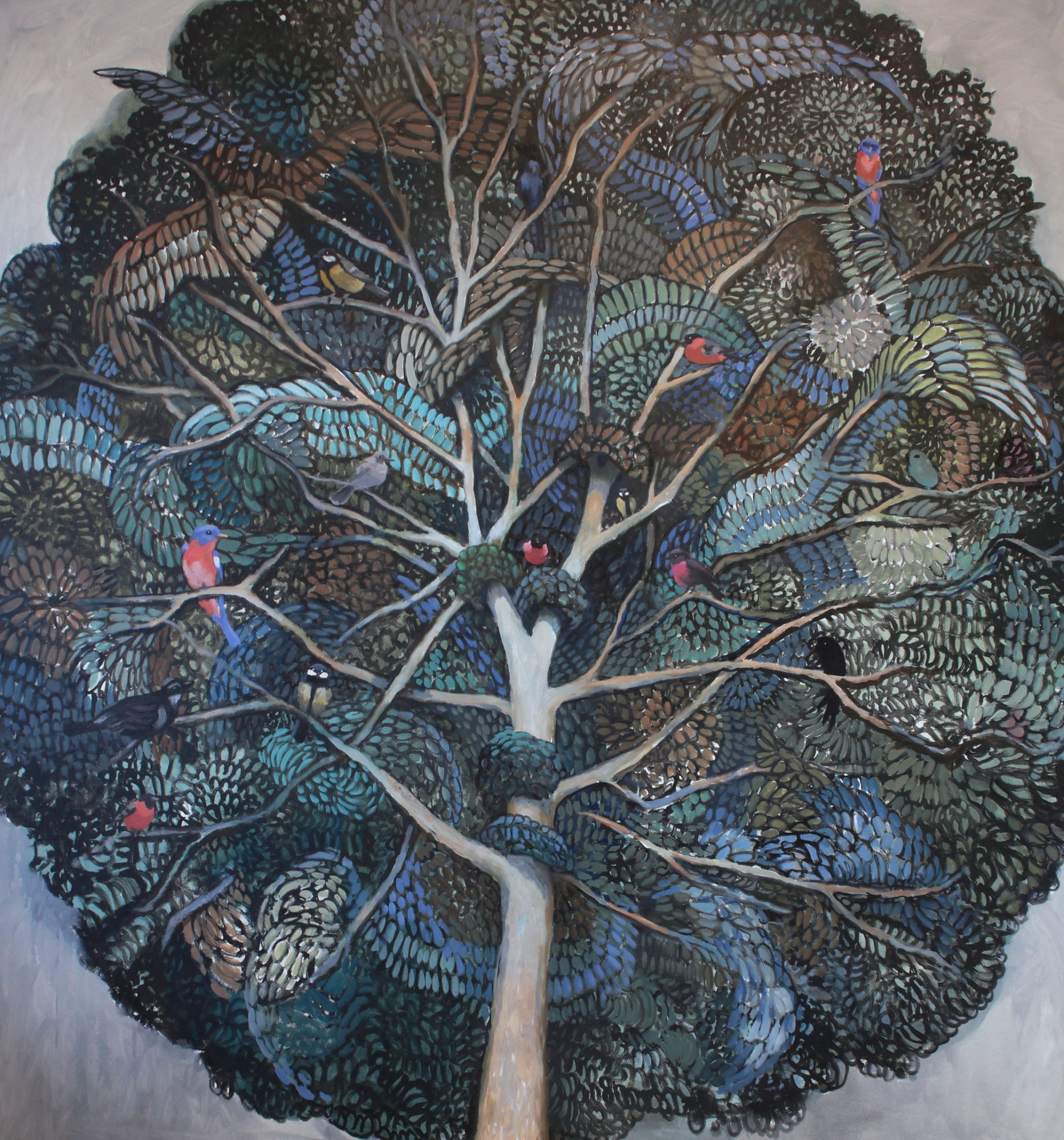 Singing Tree, 2026
acrylic and oil on canvas
150 x 140 cm
The title of my exhibition, Terra Ultra Silvam, Latin for ‘the land beyond the forest’, is an older form of the name Transylvania, which derives from the region’s geographical location relative to the Kingdom of Hungary. The two regions were separated by the dense forest of the Carpathian Mountains, making ‘the land beyond the forest’ a logical designation.
Although Transylvania is a place steeped in legend and associated with rich folklore, my exhibition is not really about the region. I was fascinated by the word Transylvania itself, both its meaning and origins. The title and unifying theme of my exhibition, Terra Ultra Silvam, was inspired by the paintings I had begun working on at the time, which feature dense forests and thickets that hide various animals in their shadows. I started imagining everything that might be found on the far side of the forest, and whom I might encounter were I to journey there.
My exhibition is divided into two parts, which are visually distinct but relate to the same animal theme that is the core of the exhibition. I decided to use a two-part structure since I often work on two different worlds simultaneously as part of my creative process. It is as if I travel along two parallel tracks when I work. The two tracks often begin to draw closer to one another and meet in unexpected ways during the final stages of the creative process. I find it compelling to bring this method that I apply in my studio to my exhibitions and encourage a dialogue between the works presented.
In my colourful, nature-inspired works, I combine animals and forest landscapes. Animals and the forest are part of the same fabric, the landscape being part of the animals themselves. I do not paint nature as it is but rather as I imagine it – a mixture of what I see and what I envision. In a dense or dark forest, we must encounter ourselves through our fears and hopes. Nature can act as a mirror. Where seeing ends, imagination begins, and it is not always clear where the boundary falls.
The black-and-white, minimalist works that feature diagrams and instructions serve as instructions for travellers. They are based on diagrams found in biology textbooks, talking animals from fairy tales and old wall charts. Yet nothing is quite as it should be, and the instructions are skewed and surprising, as though they are new house rules for modern people. The instructions contain poetry and a touch of tragic humour. For me, an essential aspect is that the instructions are juxtaposed with specific animals in the images. This creates a combination that can be used to address even difficult issues in an easy manner.
Samuli Heimonen
