



PICNIC - vol. 1Group Exhibition 17.1.2026 – 8.2.2026
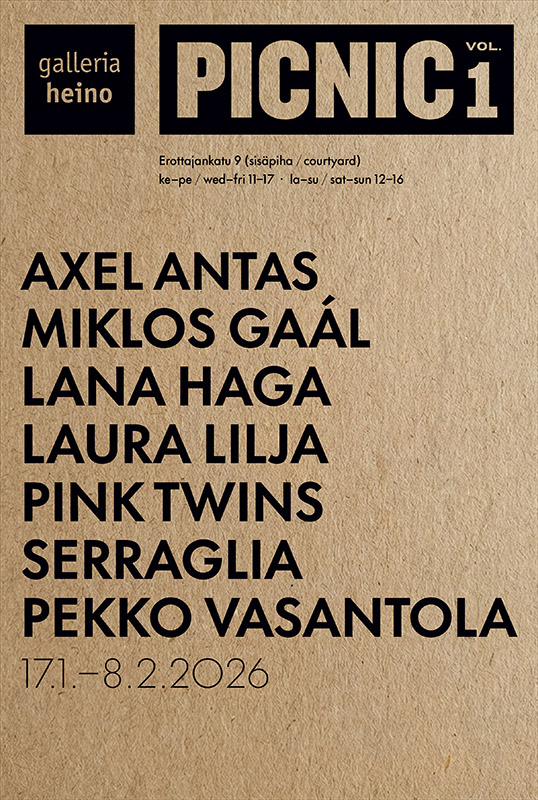
Galleria Heino’s spring season kicks off with PICNIC vol. 1, a group exhibition featuring seven artists. The works explore matters such as the interface between the representational and the non-representational, conceptually examining our everyday perceptions and addressing ecological issues. The works feature nature, landscape as well as urban environments. The techniques applied include process-based drawing that emphasises temporality, the use of camera, handicraft techniques and the manipulation of streams of digital images.
Forest (AG), 2026, a drawing of a forest by Axel Antas (b. 1976) is based on the idea of double exposure, reflections and layers. The drawing is made using silverpoint on a specially prepared surface. Silverpoint creates lines that reflect light and produce a subtly shifting effect. The work challenges and slows down the experience of viewing and approaches non-representational expression. Silverpoint is an old historic technique, which was used before the invention of graphite pencils. Marks made with silverpoint cannot be corrected, erased or softened, each line is permanent, representing a single moment in time, finally creating a drawing through a process consisting of those moments.
Miklos Gaál’s (b. 1974) work Common sense, 2024, is a video projection of shortcuts in urban space. Gaál is interested in distancing the experience of the everyday. Observations of what is ordinary, habitual and seemingly trivial become open to interpretation and invite viewers to reconsider the countless variations of shortcuts taken intuitively – and to assign meaning to what appears meaningless.
Lana Haga (b. 1986) uses industrial surplus materials, plastics and textiles in her sculptures, addressing issues of environmentally harmful overproduction and the threat of ecosystem collapse.
The free-standing sculptures in the Rebirth series are made from extruded industrial waste plastic. Their form comes from the interaction between machine, artist and chance. In her sculptures, Haga presents plastic – a material that originates from organic matter that is billions of years old – as a mark of long-term geological development as well as an impression of human time. The sculptures are like fossil records of a substance that nature produced but that has been consumed and abandoned by humankind. Beyond their underlying critical stance, Haga’s sculptures appear as creatures that present possible life forms and waver between the representational and the non-representational, evidence of forms that life can take as it adapts to changes.
In the Superposition series, Haga has worked cotton twine into meditative patterns on canvas by hand. The patterns emerge from the inherent nature and behaviour of the twine as well as the artist’s intuitive touch. Haga has also applied subtle, gradient colours of thinned oil paint or acrylic ink to enliven the twine-patterned surface. On closer inspection, the surfaces that at first appear monochromatic turn into structures that reflect nature and the universe.
The
titles of the works in the Superposition series are from Rainer Maria Rilke’s Letters to a
Young Poet (1903-1908), which Haga says captures the existential states
that underlie the artistic creative process. An audio work based on Rilke’s
poems will also be played in the exhibition space.
Both the Superposition and the
Rebirth series draw inspiration from quantum field theory, according to
which a field contains all possible directions within itself before a single
individual reality takes an established form. In Haga’s work Thousand
Possibilities in a Thousand Possible Realities, 2023, a textile sculpture
evoking anthropomorphic shapes is placed on top of a mirror on the floor. The
work examines the continual transformation of everything, shaped by the viewers’
experience as they move around it.
Like Lana Haga, Laura Lilja (b.1975) uses recycled materials in her work. The works featured in the exhibition, Cargo Green, 2025, and Industrial White, 2026, are made from discarded ratchet straps. Worn, frayed and dirty ratchet straps have been Lilja’s primary material since 2021. In recent years, Lilja has been particularly interested in ecological approaches to artmaking using recycled, borrowed and natural materials. Lilja does not treat or dye the straps but simply arranges them by hand into works she calls ratchet strap paintings. Approaching non-representational expression, the works evoke landscape-like associations while recalling global flows of goods and patterns of overconsumption through their materials.
The work by the artist duo Pink Twins, i.e. brothers Juha Vehviläinen (b. 1978) and Vesa Vehviläinen (b. 1974), Permutation Engine, 2026, is an animation that resembles a nature documentary. It runs on a computer and repeats changing simulations of virtual life forms in 20-minute sequences.
SerraGlia (b. 1979) uses urban space as a field of artistic study and, like Gaál, reinterprets our trivial everyday observations in the series of photographs (Almost) Missed: Learning from a Parking Lot, 2025. SerraGlia repeatedly photographed a column leading into a shopping centre car park over the course of 18 months, documenting the scratches, black tyre marks and flaking paint that appeared on it. When assembled, the images in the series form a mosaic-like, seemingly non-representational, painting. Conceptually, the columns appear as a temporal and visual diary that bears witness to human presence and the passage of time. Maintenance staff repainted the column several times and eventually covered it with a metal sheet. It can no longer be damaged. Its story is over.
Pekko Vasantola’s (b. 1994) work is a wearable device Carbon Dioxide Sense (Choker), 2025. Carbon dioxide has been measured directly from the atmosphere since the 1950s. Concentrations of CO2 continue to rise, but humans cannot detect this through their senses. Vasantola’s work measures the amount of carbon dioxide in the air and responds by tightening the jewel-like collar around the viewer’s neck. The degree of tightening varies according to the concentration of carbon dioxide in the air. The work serves as a reminder of the impact of one of the most talked about gases of our time on the future of humankind.
Rauli Heino
