


MIKA KARHUMemory's Echo Chamber 3.10.2026 – 25.10.2026
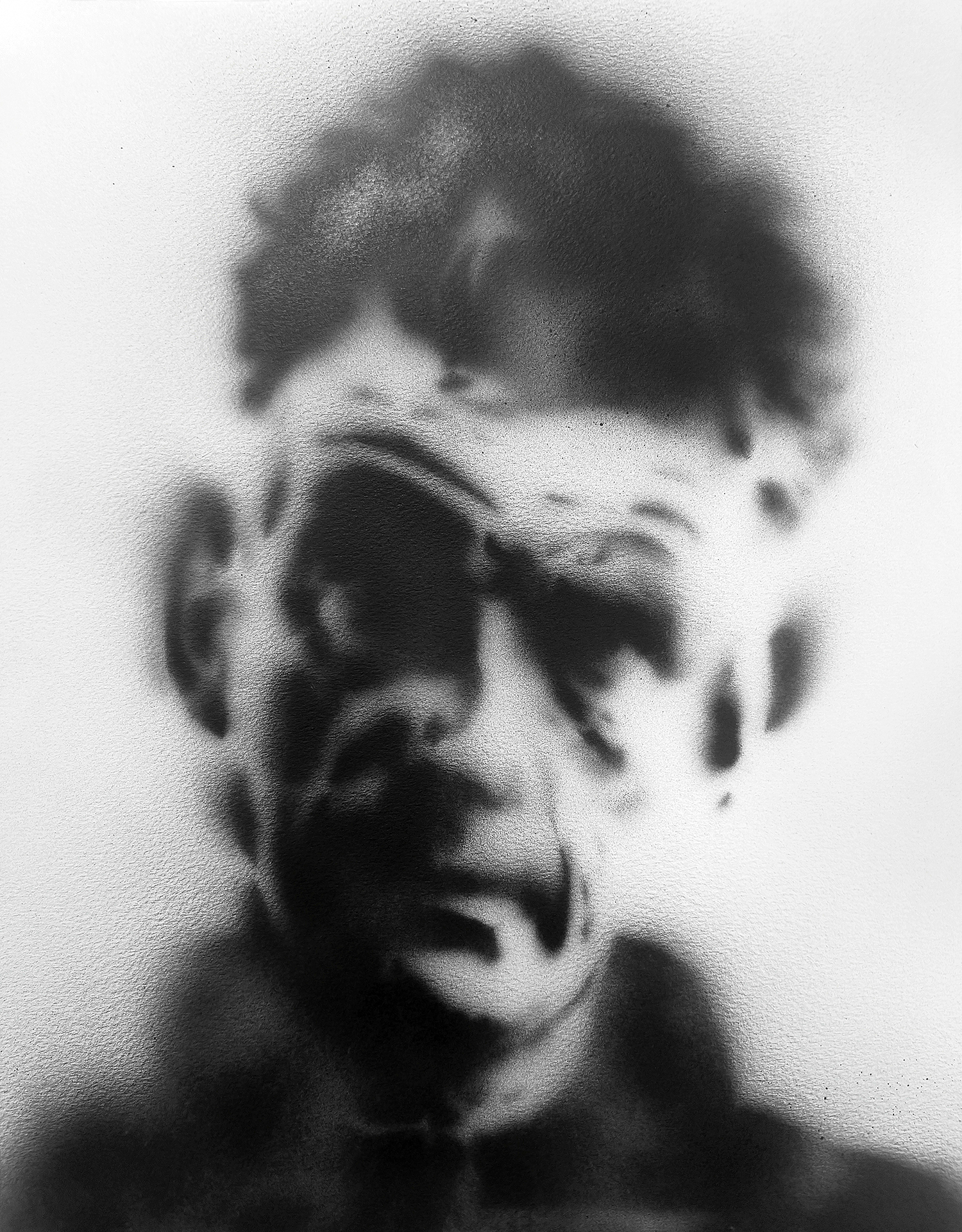 Samuel Beckett, 2026
ink spray on paper
50 x 40 cm
Memory’s Echo Chamber explores the human relationship with history, memory, and shared reality. The works begin from the premise that we are not born into a vacuum, but into a world already filled with images, narratives, structures, and layers of memory left behind by previous generations. My practice reflects on how these existing layers shape what we perceive as true, significant, and worthy of remembrance and visibility.
The figures in my works seem to appear and disappear by turns. Blurred forms, dark surfaces, and partially obscured traces slow down the act of looking: the image does not reveal itself at a single glance, nor can it be reduced to a single unambiguous interpretation. Instead, the viewer is invited to linger in a moment of uncertainty and to ask whether they are looking at a body, a movement, a memory, or the trace of an event that has already vanished. The image’s multidimensional nature does not signify ambiguity but rather an opening – for observation, memory, and alternative interpretations.
The exhibition draws on the ideas of Hegel, Nietzsche, Darwin, John Dewey, Hannah Arendt, and Theodor Adorno, particularly their thinking around history, experience, remembrance, and the resistance of reality. For me, art does not merely depict the world; it reimagines the ways in which we perceive it. At the same time, art can give visibility to experiences, contradictions, and forms of suffering that have been excluded from established historical and political narratives. It can also remind us that reality does not always align with ready-made concepts, categories, or narratives.
In today’s information culture, increasingly driven by instant recognition and facile answers, my works call for hesitation and slow contemplation. At a time when both science and art are being discredited, belittled, or subordinated to ideological and short-sighted agendas, my exhibition emphasises the importance of critical thinking, careful observation, and free artistic expression. Scientific knowledge and artistic experience do not always offer immediate or pleasing answers. Precisely for this reason, they can challenge preconceptions and reveal the complexity of reality.
Art’s critical potential arises from the fact that an image does not merely reinforce what we already know. It can allow reality to resist our interpretations. Memory’s Echo Chamber creates a space for questions, uncertainty, and incompleteness – the conditions that keep both science and art open to the unknown.
Mika Karhu
Mika Karhu
is a Doctor of Fine Arts, contemporary artist, and researcher. He is known for
his black-and-white charcoal and ink drawings and installations. Karhu is a
founding member of the TOOLBOX artists’ cooperative, which has operated its own
gallery in Berlin for fourteen years. Karhu has held numerous solo exhibitions
in Germany and elsewhere in Central Europe and has participated in numerous
group exhibitions. His works are held in collections including the Museum of
Contemporary Art Kiasma, HAM Helsinki Art Museum, the Jenny and Antti Wihuri
Foundation (Rovaniemi Art Museum), EMMA – Espoo Museum of Modern Art, and the
Finnish State Art Commission. In 2009, Karhu was nominated for the Ars Fennica
Prize. In 2026, he published Änkyttävä maailma – esseitä taiteesta,
vallasta, elokuvasta ja semiotiikasta, an anthology of essays on art,
power, film, and semiotics.
(English translation by Silja Kudel.)
